



Wild Safaris In India

Wild and Exciting Safaris & Tours in India

One of the few bits of good news in the motorcycle industry these past few years, at least in America, is that many of the too-cool-for-the-States Euro-only models have finally dropped anchor and headed to the New World. The U.S. gets one such ride, Yamaha’s FZ8, as a 2011 model.just got a first taste of the new Fazer on a 100-mile run in California’s Santa Monica Mountains, discovering a fun-to-ride and versatile new middleweight.
The FZ8 expands what Yamaha dubs its Total Sportbike line, a designation applying to the high-performance Supersport R1 and R6, as well as the Sport-Touring FJR1300. In between are models Yamaha designates as its Sport models: the fully-faired FZ6R, half-faired FZ1 and the naked FZ8.

(MIC), Yamaha claims the Total Sportbike segment of the industry has held steady from 2005 thru 2010 at 20% (cruisers maintain the top position at 45-50% of sales). Within the Total Sportbike category itself, however, the Supersport segment has dropped from 65% to 49% over that six-year stretch. Picking up the slack, the remaining Sport models are up from 29% to 37%, with Sport-Touring bikes more than doubled from 6% to 14%.
Other market indicators deemed favorable for the FZ8 include a growing trend of riders no longer purchasing multiple specialist bikes, but instead investing in a single, more versatile mount. Add in Yamaha’s own customer feedback, which put Rider Position and Price/Deal as their most important purchasing reasons, and Yamaha makes a strong case for its new naked standard.
The FZ8 sources a familiar looking Inline Four, which shares the pre-crossplane R1 pedigree of its larger-displacement FZ1 sibling. The engine cases are in fact identical with FZ1, along with the 53.6mm stroke. But the FZ8 displaces 779cc courtesy of its sleeved down 68mm bore (77mm on FZ1). The FZ8 mill further diverges with a new four-valve cylinder head (five-valve head on FZ1) and higher 12.0:1 compression ratio. Mellower cam profiles and revised valve timing tune the FZ8 for low and mid-range power, rather than the top-end bias of the FZ1, the latter bike also sporting a 500 rpm higher redline at 12K.

Variable length intake funnels further refine the engine’s power characteristics. No, it’s not the movable YCC-I system from the R1, rather the outside cylinders are 125mm long, while the middle two cylinders route air from the 7.8-liter airbox through 150mm length funnels. Other internal changes include a narrower throttle bore than the FZ1. The other major change from the FZ1 mill is a lighter crankshaft, with Yamaha claiming a 30% reduction in inertial mass. While giving the engine a quick revving character and smooth throttle response, the company touts the crank’s the reduced rotational force “contributes to light and responsive handling.”
Well-suited to a bike pitched as a step-up model, the engine’s broad powerband has something for all skill levels. The low end churns out ample, yet manageable power, complemented by a forgiving throttle input. Approaching 6K on the tach and a fantastic mid-range zing kicks in. Squeeze the throttle between 6 and 9K and riders had best have firm grip on the controls, because it hauls. Fueling across the powerband is immediate without being abrupt, a very tricky formula to master. The engine’s smooth character holds throughout the revs as well, with no rattling or overt vibes until it buzzes up near the 11.5K redline.
Yamaha refuses to state power claims for this model, but our seat-of-the-pants dyno would confirm its middleweight displacement. It’s got more oomph than a 600 street bike, but lacks the potency of the FZ1 or 1043cc Kawasaki Z1000. In fact, the engine performance it’s most analogous in our estimation to the defunct-in-the-US Kawi Z750, which we fondly recall from many a riding season past.

A 4-2-1 exhaust system exits out a black, right-side muffler. We found the exhaust sound muted but favorable, with a more robust melody wailing at the upper revs. Keeping it revved out doesn’t help with fuel economy though, and the Fazer seemed to suck down the gas during our test ride. Yamaha reps promise a 200-mile range from the 4.49-gallon tank, a claim we’ll test in a future comparison review.
The FZ8’s six-speed transmission features lower first gear and secondary reduction gear ratios than the FZ1. We found no fault with the gearing, the low first gear praiseworthy for allowing riders to creep along at low speeds without clutch finesse and little to no throttle modulation. The cable-actuated clutch delivers seamless engagement, while the lever pull felt stiffer than ideal but tolerable.
The FZ8’s cast aluminum frame and swingarm are identical with the FZ1. Same goes for the 57.4-inch wheelbase, 32.1-inch seat height and steering geometry. Swing a leg over the 8, however, and it feels smaller than our recollections of its bigger displacement kin. This may be in part due to the missing half fairing (a half-faired version of the FZ8 is available in Europe), but the seat and tank junction have also been slimmed down to deliver an easy reach to the ground (fuel capacity shaved by a little over a quarter-gallon). Smaller riders noted the FZ8 dimensions were easy to handle and not intimidating, and taller riders didn’t feel overbearing on the new model.
Slight repositioning of the handlebars (5mm forward) and footpegs (15mm backward, 10mm downward), compared to the FZ1, deliver a subtle forward pitch for the rider. Increased wind resistance from the naked design counteracts the forward cant, so no pressure is placed on the rider’s wrists or lower back. The standard position makes for a comfortable saddle, though we’d rate the seat only average – comfy for showroom floors and short jaunts, but lacking as the tripmeter turns into triple digits.

Get up to speed and the FZ8 turns in and transitions without much effort at the controls, the front-end light and intuitive when the road kinks up. Here’s where the Yamaha’s assertion of improved handling from the lighter crankshaft come into play. We’ll buy into the claims, as the FZ8 proved more nimble than our recollections of the FZ1 (we last tested the FZ1 during our 2007 Streetfighter Comparison, where it was deemed less svelte than its competitors), though we reckon this could also be owed to the half-inch narrower rear tire. Certainly the FZ8 feels lighter than the 15-pound spec sheet variances of the two FZ models.
The FZ8’s suspension is non-adjustable, save for nine-position preload adjustment for the rear shock. The inverted 43mm KYB fork works sound enough, set up well for its street use. Riders who find the fork’s performance limiting figure to already be drawn to the higher-spec FZ1, which sources fully adjustable KYB sticks. The YHSJ rear shock (Yamaha’s subsidiary suspension company formerly known as SOQI) is less adept. Sprung on the soft side, the FZ8’s rear end wallows when pushed hard on poor road surfaces. Riders in our test group who added preload reported improvement, but the shock would benefit from more rebound.
Braking performance is solid courtesy of the dual front 310mm discs and four-piston, non-radial-mount Sumitomo calipers. The single 267mm single-piston Nissin rear isn’t terribly impressive, but the overall package proves quite effective at bringing the 470-pound (claimed) bike to a safe and speedy halt. ABS is not available as an option.
The FZ8’s $8490 MSRP beats its direct competitors and falls under that imposing 10K mark by a full $1500. Fit and finish on the bike is decent, but not flawless, with things like the flimsy mount of the wind cowling somewhat detracting. Instrumentation is simple and easy to read, with our favorite perks like a gear position indicator absent but not missed. As bikes get more and more complicated the simplicity is refreshing.
On the styling end, the FZ8 is not a particularly edgy bike. That said, it plays to our particular sensibilities, with its naked profile and exposed header pipes our favorite trait. As far as colorways go, as Henry Ford once said of his Model T, the FZ8 can be had in any color the customer wants, so long as it’s black. Riders can, however, kit out their Fazer with numerous factory accessories including some extra bodywork and useful add-ons like a centerstand.
All told the FZ8 is a fun bike to ride and an exciting new middleweight option from Yamaha. The Tuning Fork logo makes a compelling case for its latest model’s success, even in the current distressed market conditions and traditional low sales of naked street bikes in the States. Now it’s up to the American ridership to decide if these Euro-only bikes are Euro-only for a reason.

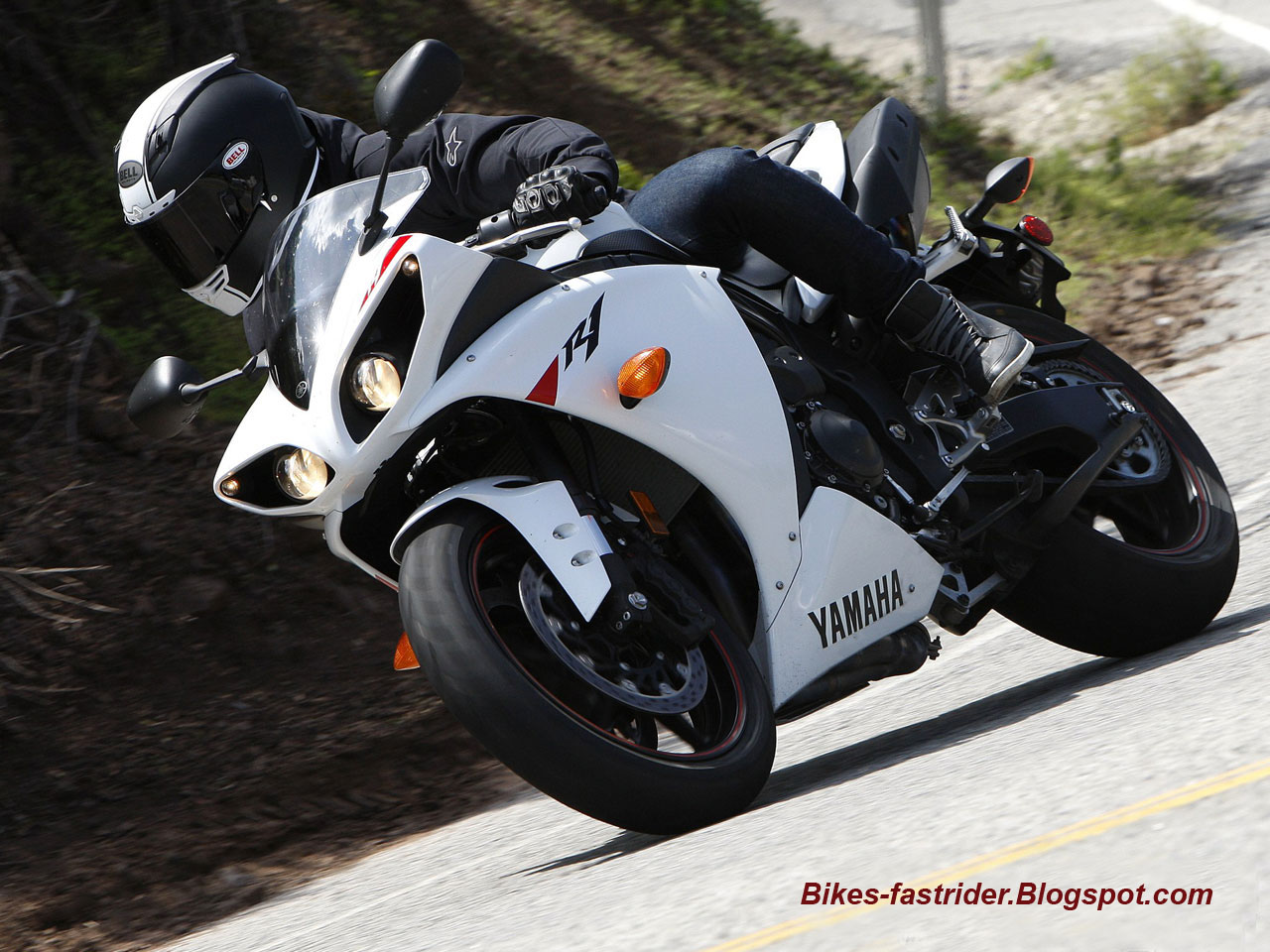
Mostly unchanged for 2010, the new-in-’09 Yamaha R1 came into our shootout much better prepared and with a rock-solid base set-up this time around. The boys in blue found that our handling problems last year were due in part to an unusual issue within the fork. And with that remedied, the Yamaha produced a much more consistent performance, the same one we were quite fond of at the 2009 Yamaha YZF-R1 First Ride in Australia last year.
Nearly all those who threw a leg over the R1 found its suspension much more compliant than the previous bike. It was balanced, composed and worked in unison throughout the stroke. However, with a fork that would dive quite quickly under braking and a rear shock that transferred a great deal of weight led to mixed feelings about the Yamaha’s suspension. I can tell you without a doubt that the suspension is virtually perfect for street riding, but as a whole the R1 is still on the soft side when subjected to pure racetrack abuse.

“Like the BMW, the Yamaha forks were pretty solid until you put that extra load on them during some of the faster laps,” explains fast club-level racer Frankie Garcia. “The front end would push ever so slightly at a fast pace. Also, when braking into a corner hard the front end would dive a lot.”
Sorensen adds: “Again the rear was set up much more balanced this year. The bike had good attitude as you set it into the corner, tracking bumps well on the gas. But I think overall, I would like a more ridged set-up front and rear to give more feedback – it just transfers a great deal of weight no matter what one does when pushing hard.

Also receiving mixed views was the crossplane crankshaft engine. The smooth power delivery allows easy, graceful drives off the corners, no matter one’s skill level. Not to mention a unique sound that nearly everyone found soothing and easy on the ears. As for the mixed side: There’s a lack of top end. Other than the KTM, the R1 falls off the most up top when it’s being pushed hard. Even so, many rated the bike as being extremely easy to ride and it was mid-pack this year in terms of outright quickest lap times, a big leap forward from last year.
“One word: La-Z-Boy,” Hensley comments “That’s how this thing feels. Like a big, comfortable La-Z-Boy. Believe it or not, that’s a compliment. This is a bike that you know you could ride the hell out of if you chose to and it’s not going to bite you in the ass…It has really friendly power and I like the sound.”
Hutch agrees with Hensley. “I get along well with the R1. It is less intimidating than the GSX-R, Ninja or the BMW and that allows you to focus on riding a bit more and not stressing out so much about getting high-sided.”
Fast-guy Earnest’s impressions somewhat reflected those of the others as well, though he noticed some added seat-of-the-pants power compared to the ’09 bike. “The engine seems faster than last year’s test bike,” he says. “It has the easiest power delivery of the bunch, feeling more like a Twin than an Inline Four. But it just seems to take too long to rev out.”
This slow-building power showed up right away when we got the R1 up on Lee’s Cycle’s dyno, the bike turning the rear wheel to the tune of 150.89 hp and 76.55 lb-ft of torque. While nothing to scoff at, in this field it’s playing at the back of the pack. The performance numbers at El Toro were matching as the R1’s 10.22 ET @ 138.4 mph in the quarter-mile was at the rear of the group.
Some of this comes down to the fact that it’s tough to get a good launch thanks to its somewhat feeble clutch. The light clutch action is nice on the street and track but when it comes to hard drag strip launches it’s very difficult to keep it behaving correctly and as a result it posted the lowest elapsed time and speed through the trap. It’s also worth noting that by the end of our performance testing the clutch cable was adjusted all the way out, a telling sign that the clutch plates were on their final leg.

However back on the track, the Yamaha transmission and clutch scored right in the middle of the pack by our test riders; it held up to the day’s abuse without issue. A couple riders noted a slightly “mushy” feeling, while most of the others were impressed with the ease of lever operation and didn’t have the slightest issue.
“The Yamaha shifts quick and smooth, though I missed a downshift on corner entry, but that could have been my fault,” says Earnest. Sorensen’s comments were along the same line, the champ saying that the “Yamaha used to have a chunkier tranny, but all that is gone. It’s smooth, short-throw shifts; I had no complaints.”
But the brakes were an area where the R1 continued to struggle. While feel and feedback were better than last year, with a less wooden feel to them, the initial bite was lackluster and they had a tendency to fade over the course of long runs. As such, most riders found them to be merely average. And in this cutthroat group, average just doesn’t make the grade. The word “soft” came up often in the rider’s opinions. And out at El Toro its 133-foot braking distance from 60 mph was at the back of this tightly-packed bunch. Though one will note that six of the eight bikes were within 10 feet of each other and it was only 15 feet from first to last.

“Not bad brakes but a bit soft in the lever,” says Neuer of the R1. Hensley’s comments were nearly the exact same thing, adding that “the brakes are soft, kind of like everything else on the Yamaha. As a whole the bike just feels very relaxed.”
A look at the data shows middle-of-the-road acceleration numbers exiting Turn 6 at 0.66g, though coming out of the final, slower corner it struggled, with a best of 0.63g, putting it third from the back. Though despite the “soft” feeling brakes, it still produced some of the best braking g-force numbers going into Turn 14 at -1.21g.
But where the Yamaha shined was its class-leading maximum grip figure in Turn 2, sticking to the pavement at the tune of 1.2g as a result of the balanced set-up and solid chassis. Though it didn’t produce the highest grip in the final set of corners, the 1.3g it was capable of in Turn 15 put it at the pointy end of the field. It may not have been the easiest to get settled into a turn, but once on its side the chassis was a thing a beauty.
“As soon as both wheels were planted it was all good,” Earnest says. “It may have backed in a bit entering the corner, but once leaned over that R1 was very planted.”
It was also respectable down the front straight, reaching a top speed of 150.7 mph, which was right on par with the Kawasaki and the Aprilia, while ahead of the KTM and the Suzuki. All told the Yamaha ticked off a 1:57.55 as a best Superpole lap, landing it just outside mid-pack, though much closer to the competition than last year.

Even after a couple years in production, it’s still impossible not to talk about the sound that the Yamaha makes. More like a V-Twin and a V-Four mix than an Inline Four, there’s no question the R1 makes music to any motorcycle junkie’s ears.
How can you not love the way the Yamaha sounds? “It’s not like anything on this planet and every time it made a pass down the front straight it gave me tingles down my spine. I like the sound when hearing it from the sidelines as well as from the saddle. It’s almost soothing, makes me feel relaxed but fast when riding.”
As a purely track-based test, the stock Yamaha cannot compete for top honors. Its lower horsepower numbers, high curb weight and soft suspension held it back from running at the front both on the racetrack and at the airstrip during performance testing. And when it comes to an overall ranking, that’s the majority of how the track test is evaluated. But that doesn’t mean there isn’t something special about the Yamaha. With its iconic R1 styling and the awesome sound of that unorthodox engine, there’s no question the Tuning Fork superbike exudes character from every last turn of the crossplane crank. We’ve liked this bike immensely since first riding it more than a year ago and nothing about that has changed. It’s just that in the company of this test on the racetrack the points happen to put it at the back of the class. As for on the street, well that’s a totally different story…

A low seat, great handling, extra wide tires, and, most importantly, a burly 4-stroke engine, have cemented the TW200's reputation as a fantastic dual purpose ride. Whether you are a beginner or a veteran; a camper or a city dweller, this bike guarantees good times.

The 2008 Yamaha TW200's low, thick seat, sport/plush suspension and those distinctive fat tires all work together to serve up a smooth ride over all sorts of surfaces. Ges up and go!
Break your next trail with the 2008 TW200, a unique machine that's hugely popular with beginners and veterans alike.

The gritty, muscular 4-stroke engine delivers smooth, reliable torque with the push of the electric starter button. Running around the campsite, heading into town for supplies, or making your way down to your favourite fishing hole, this bike is always as ready to go anywhere as you are. With a low seat height, superior handling, and unique wide tires, you can get there with confidence and have big-time fun along the way.

FEATURES:
Strong-pulling, 196cc, air-cooled, SOHC, 2-valve, 4-stroke single delivers torquey low- and mid-range power perfectly suited to off-road exploring.
Internal engine counterbalancer keeps vibrations down for great all-day comfort.
Maintenance-free CDI ignition system ensures precise, reliable spark for peak engine performance at all RPMs and easy starting.
Automatic cam chain tensioner reduces maintenance and engine noise.
Teikei 28mm carb provides crisp throttle response.
Smooth-shifting, 5-speed transmission with manual clutch puts power to the ground for great on- and off-road performance.
Washable, foam air filter reduces maintenance costs.
Environmentally friendly exhaust system produces a quiet note. Heat shield protects rider from hot components.

Rugged, diamond-type, high-tensile steel frame
Lightweight, box section swingarm is fitted with easy-to-use eccentric chain adjusters. There are grease fittings at the swingarm pivot points.
33mm front fork with 160mm (6.3") of wheel travel soaks up the bumps for a plush ride. Rubber fork boots keep dirt out of seals for extended life.
Monocross link rear suspension uses a single rear shock. Rear wheel travel is 150mm (5.9") to smooth the roughest trails.
220mm front disc brake with twin piston caliper ensures great stopping power. Wide, 130/80-18 front and 180/80-14 rear tires deliver extra traction and rider comfort over a wide range of terrain, and also help make the TW200 the most distinct-looking dual purpose machine in the industry.
Low, 790mm (31.1") seat height and compact chassis design helps inspire confidence by letting most riders put both feet down when stopped, making the TW200 one of the most user-friendly on/off-road bikes on the market.
Rear drum brake with easy-to-use, wing nut style adjuster
Lightweight, aluminum alloy front and rear rims are fitted with street-legal, dual purpose tires.
Long, motocross-style seat creates a balanced riding position for optimal rider movement and comfort. Stylish, two-tone colour scheme.
Durable and wide fenders keeps mud and dirt off the rider when taking one's exploring off-road.
Frame-mounted passenger footpegs provide two-up riding capability.
 While the nearly naked FZ6 sported an aluminum chassis and a high-strung engine from the previous generation R6, the fully faired FZ6R carries the styling of a supersport but in an affordable package. The FZ6R is fills a price point in the model line as well as aiming at women riders and entry-level sportbike lovers
Emerging as an all-new model for Yamaha, the FZ6R bursts onto the scene in four vivid colors and graphics packages. Here you see the yellow stunter edition. Rumor has it the yellow bikes have more horsepower.
Emerging as an all-new model for Yamaha, the FZ6R bursts onto the scene in four vivid colors and graphics packages. Here you see the yellow stunter edition. Rumor has it the yellow bikes have more horsepower.
 Yamaha has just introduced comfort to the commuting sportbike crowd. We’ve seen a lot of price-driven bikes crop up lately - cheaper bikes for a softer market - and Yamaha steps up the plate with a great looking player.
While the sportier FZ6 is still available for the pure more experienced riders with a starting MSRP just $300 higher, the FZ6R dips below the $7000 mark and comes with a new steel chassis and a completely revised and retuned 600cc inline 4-cylinder DOHC powerplant that’s is sure to please many newcomers.
New riders can expect to find an all-new steel frame and swingarm with comfortable and adjustable rider positioning to provide a bike that you won’t soon outgrow. The 30.9-inch saddle seat height (FZ6 is 31.3) can be raised 20mm from the stock position, while the bars can also move 20mm forward by rotating the bar mount columns with the included tool kit. Compared to the FZ6 model, the handlebar is 12mm rearward and 12mm lower. The seat position is 4mm forward and 2mm lower than the FZ6.
The relaxed geometry, tighter rider triangle, tuned-for-low-to-mid powerband and R-bike styling make the FZ6R a notable addition to Yamaha’s sportbike line-up.
The relaxed geometry, tighter rider triangle, tuned-for-low-to-mid powerband and R-bike styling make the FZ6R a notable addition to Yamaha’s sportbike line-up.
Yamaha breaks down its “sportbike” category into three sub-classes: Supersport, Sport and Sport-Touring. Their research says 60% of its first-time buyers choose a Supersport bike like the R6 and R1, both of which aren’t exactly newbie friendly. Just 32% of these consumers chose an FZ1 or FZ6 from the Sport category.
The new FZ6R sports a redesigned engine from the crankcases on up.
 But the Sport class has seen mild surges in sales for the past three years, surely due to more economically minded buyers in the market. They want sporty bikes as well as great fuel mileage and comfort. They also want to blend in with their friends’ sportbikes but don’t wanna be uncomfortable doing it. This is where the relaxed riding position of the new FZ6R meets the aggressive style of the YZF-R line. The lower price point and lower saddle heights probably don’t hurt either. The option might appear redundant on the OEM’s part, but it’s providing the buyer a better fit of the rider physique and the pocketbook.
These ‘entry sport’ bikes as Yamaha calls them - sub 750cc sportbikes - are at a 5-year sales high with nearly 43,000 units selling in 2008. Yamaha only had an 8% take in that overall market number last year with just one model (the FZ6), and it hopes to make a bigger splash with the addition of the friendlier FZ6R in 2009. If you’re considering the R6 but don’t need the power or want the price, consider taking home the FZ6R.
Efficiency runs deeper than just through your wallet. When compared to FZ6, the 6R gets 8% better fuel economy thanks in part to its 4mm smaller throttle bodies and milder state of tune, plus the narrower 160mm rear tire compared to the 180 on the FZ6. A freshly engineered clutch (inner push type versus outer pull) and new crankcase castings are also part of the FZ6R. Despite being 8 lbs heavier (11 pounds in Cali), the FZ6R is said to get 43 mpg versus the 40 mpg of the FZ6.
The rigidly mounted engine (a stressed member) is hung from a diamond-steel frame and suspended by a non-adjustable 41mm conventional Soqi fork and an easily accessible 7-step preload-adjustable-only Soqi monoshock rear. To keep newbies comfortable and safe, the 6R’s rake is lazy 26.0 degrees, 1.0 shallower than the FZ6, while trail is slightly increased to 104mm. The tubular handlebar is set up to facilitate a tight turning radius.
Taller riders will appreciate the additional near inch provided by the adjustable saddle.
 one will notice the lack of punch at the whack of the throttle. The 6R has a milder state of tune, and this pays off with power being available at revs that are more easily accessible – no need to zing it to redline. The engine gains speed slowly but deliberately, accompanied by a slight buzz after 7000 rpm.
Comfy ergonomics and ample wind protection are two of the rider-friendly attributes of the FZ6R.
When it’s time to slow down, the front and rear Brembo master cylinders pipe that stopping power through a 5-way adjustable lever to a pair of dual-piston pin-slide Akebono calipers up front gripping two 298mm rotors. Providing adequate power for the bikes intended audience, they’re not up to the standards of power and feel as racier sportbikes. The rear single-piston pin slide Nissin caliper chomps on a 245mm rotor, the same as found on the FZ6 model.
The all-black FZ6R Raven model has an MSRP of just $6,990 while the Team Yamaha Blue/White, Cadmium Yellow and Pearl White paint and graphic schemes run slightly higher at $7,090. Each color has a different graphics package – two are traditional Yamaha and two are more in line with the flashy and cool R6 designs.
The FZ6R is a worthy option for someone who wants a practical and easy-to-ride bike yet wants some sporty styling and responses.
YAMAHA announced the new 2009 V-max . It's appearance will never be mistaken for any other motorcycle with strong ties to the past but it’s decidedly a break from the old Max, more up to date with contours more muscular and an all new 1679cc engine with fly by wire throttle, functional air scoops and Yamaha Chip Controlled Intake (YCC-I) that shortens the intake tracts at 7000 rpm.The new VMAX is an allnew 1679cc liquid-cooled 4-stroke DOHC 65 degree V4 engine which has been designed to offer an unforgettable acceleration experience created by higher levels of power, and an imposing design. Running with bore x stroke dimensions of 90.0 x 66.0mm (compared to 76.0 x 66.0mm for the previous model VMAX) and featuring a compression ratio of 11.3:1, this visually intimidating new powerplant develops 147.2 kW (200 bhp at 9000 rpm, together with a huge torque output of 166.8 Nm (17.0 kg-m) at 6500 rpm.The VMAX's new diamond-type frame has been developed using Yamaha's industry-leading chassis design and manufacturing technology, and features an immensely strong yet lightweight structure that is made up from a variety of gravity-cast, CF die-cast and extruded aluminium sections. This innovative new design incorporates gravity-cast components for the main frame and pivot assembly, while the rear frame is made from a range of Yamaha's exclusive CF die-cast parts and extruded parts which are welded together.


 EngineType 1679cc liquid-cooled 65° V-4, DOHC, 4 valves/cylinderBore x Stroke 90.0mm x 66.0mmCompression Ratio 11.3:1Fuel Delivery Fuel Injection with YCC-T and YCC-IIgnition TCITransmission 5-speed, multiplate slipper clutchFinal Drive Shaft
Chassis
Suspension/Front 52mm telescopic cartridge fork w/oxidized titanium coating. Fully adjustable preload, compression and rebound; 4.7 in travel
Suspension/Rear Single shock w/remote reservoir and remote adjustable for preload, compression and rebound
Brakes/Front Dual 320mm wave-type discs; radial mount 6-piston calipers, Brembo® radial pump master cylinder
Brakes/Rear 298mm wave-type disc, single-piston caliper and Brembo® master cylinder
Tires/Front Bridgestone® Radial 120/70-R18 59V
Tires/Rear Bridgestone® Radial 200/50-R18 76V
Dimensions
Length 94.3 in
Width 32.3 in
Height 46.8 in
Seat Height 30.5 in
Wheelbase 66.9 in
Rake (Caster Angle) 31.0 in
Fuel Capacity 4.0 gal
Wet Weight 683 lb / 685 lb (CA model)


