



Wild Safaris In India

Wild and Exciting Safaris & Tours in India
Showing posts with label fast-bikes. Show all posts
Showing posts with label fast-bikes. Show all posts

Mostly unchanged for 2010, the new-in-’09 Yamaha R1 came into our shootout much better prepared and with a rock-solid base set-up this time around. The boys in blue found that our handling problems last year were due in part to an unusual issue within the fork. And with that remedied, the Yamaha produced a much more consistent performance, the same one we were quite fond of at the 2009 Yamaha YZF-R1 First Ride in Australia last year.
Nearly all those who threw a leg over the R1 found its suspension much more compliant than the previous bike. It was balanced, composed and worked in unison throughout the stroke. However, with a fork that would dive quite quickly under braking and a rear shock that transferred a great deal of weight led to mixed feelings about the Yamaha’s suspension. I can tell you without a doubt that the suspension is virtually perfect for street riding, but as a whole the R1 is still on the soft side when subjected to pure racetrack abuse.

“Like the BMW, the Yamaha forks were pretty solid until you put that extra load on them during some of the faster laps,” explains fast club-level racer Frankie Garcia. “The front end would push ever so slightly at a fast pace. Also, when braking into a corner hard the front end would dive a lot.”
Sorensen adds: “Again the rear was set up much more balanced this year. The bike had good attitude as you set it into the corner, tracking bumps well on the gas. But I think overall, I would like a more ridged set-up front and rear to give more feedback – it just transfers a great deal of weight no matter what one does when pushing hard.

Also receiving mixed views was the crossplane crankshaft engine. The smooth power delivery allows easy, graceful drives off the corners, no matter one’s skill level. Not to mention a unique sound that nearly everyone found soothing and easy on the ears. As for the mixed side: There’s a lack of top end. Other than the KTM, the R1 falls off the most up top when it’s being pushed hard. Even so, many rated the bike as being extremely easy to ride and it was mid-pack this year in terms of outright quickest lap times, a big leap forward from last year.
“One word: La-Z-Boy,” Hensley comments “That’s how this thing feels. Like a big, comfortable La-Z-Boy. Believe it or not, that’s a compliment. This is a bike that you know you could ride the hell out of if you chose to and it’s not going to bite you in the ass…It has really friendly power and I like the sound.”
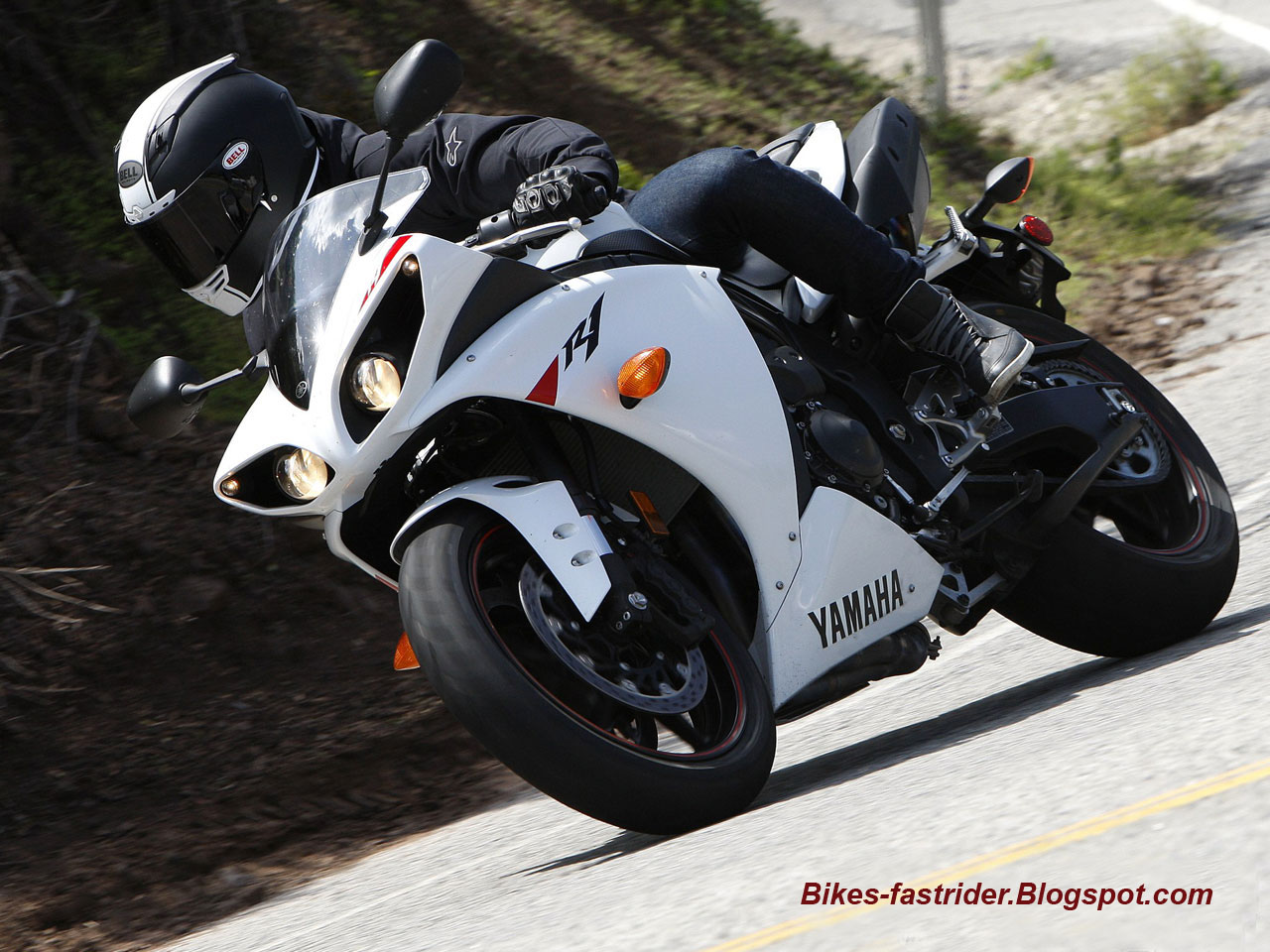
Hutch agrees with Hensley. “I get along well with the R1. It is less intimidating than the GSX-R, Ninja or the BMW and that allows you to focus on riding a bit more and not stressing out so much about getting high-sided.”
Fast-guy Earnest’s impressions somewhat reflected those of the others as well, though he noticed some added seat-of-the-pants power compared to the ’09 bike. “The engine seems faster than last year’s test bike,” he says. “It has the easiest power delivery of the bunch, feeling more like a Twin than an Inline Four. But it just seems to take too long to rev out.”
This slow-building power showed up right away when we got the R1 up on Lee’s Cycle’s dyno, the bike turning the rear wheel to the tune of 150.89 hp and 76.55 lb-ft of torque. While nothing to scoff at, in this field it’s playing at the back of the pack. The performance numbers at El Toro were matching as the R1’s 10.22 ET @ 138.4 mph in the quarter-mile was at the rear of the group.
Some of this comes down to the fact that it’s tough to get a good launch thanks to its somewhat feeble clutch. The light clutch action is nice on the street and track but when it comes to hard drag strip launches it’s very difficult to keep it behaving correctly and as a result it posted the lowest elapsed time and speed through the trap. It’s also worth noting that by the end of our performance testing the clutch cable was adjusted all the way out, a telling sign that the clutch plates were on their final leg.

However back on the track, the Yamaha transmission and clutch scored right in the middle of the pack by our test riders; it held up to the day’s abuse without issue. A couple riders noted a slightly “mushy” feeling, while most of the others were impressed with the ease of lever operation and didn’t have the slightest issue.
“The Yamaha shifts quick and smooth, though I missed a downshift on corner entry, but that could have been my fault,” says Earnest. Sorensen’s comments were along the same line, the champ saying that the “Yamaha used to have a chunkier tranny, but all that is gone. It’s smooth, short-throw shifts; I had no complaints.”
But the brakes were an area where the R1 continued to struggle. While feel and feedback were better than last year, with a less wooden feel to them, the initial bite was lackluster and they had a tendency to fade over the course of long runs. As such, most riders found them to be merely average. And in this cutthroat group, average just doesn’t make the grade. The word “soft” came up often in the rider’s opinions. And out at El Toro its 133-foot braking distance from 60 mph was at the back of this tightly-packed bunch. Though one will note that six of the eight bikes were within 10 feet of each other and it was only 15 feet from first to last.

“Not bad brakes but a bit soft in the lever,” says Neuer of the R1. Hensley’s comments were nearly the exact same thing, adding that “the brakes are soft, kind of like everything else on the Yamaha. As a whole the bike just feels very relaxed.”
A look at the data shows middle-of-the-road acceleration numbers exiting Turn 6 at 0.66g, though coming out of the final, slower corner it struggled, with a best of 0.63g, putting it third from the back. Though despite the “soft” feeling brakes, it still produced some of the best braking g-force numbers going into Turn 14 at -1.21g.
But where the Yamaha shined was its class-leading maximum grip figure in Turn 2, sticking to the pavement at the tune of 1.2g as a result of the balanced set-up and solid chassis. Though it didn’t produce the highest grip in the final set of corners, the 1.3g it was capable of in Turn 15 put it at the pointy end of the field. It may not have been the easiest to get settled into a turn, but once on its side the chassis was a thing a beauty.
“As soon as both wheels were planted it was all good,” Earnest says. “It may have backed in a bit entering the corner, but once leaned over that R1 was very planted.”
It was also respectable down the front straight, reaching a top speed of 150.7 mph, which was right on par with the Kawasaki and the Aprilia, while ahead of the KTM and the Suzuki. All told the Yamaha ticked off a 1:57.55 as a best Superpole lap, landing it just outside mid-pack, though much closer to the competition than last year.

Even after a couple years in production, it’s still impossible not to talk about the sound that the Yamaha makes. More like a V-Twin and a V-Four mix than an Inline Four, there’s no question the R1 makes music to any motorcycle junkie’s ears.
How can you not love the way the Yamaha sounds? “It’s not like anything on this planet and every time it made a pass down the front straight it gave me tingles down my spine. I like the sound when hearing it from the sidelines as well as from the saddle. It’s almost soothing, makes me feel relaxed but fast when riding.”
As a purely track-based test, the stock Yamaha cannot compete for top honors. Its lower horsepower numbers, high curb weight and soft suspension held it back from running at the front both on the racetrack and at the airstrip during performance testing. And when it comes to an overall ranking, that’s the majority of how the track test is evaluated. But that doesn’t mean there isn’t something special about the Yamaha. With its iconic R1 styling and the awesome sound of that unorthodox engine, there’s no question the Tuning Fork superbike exudes character from every last turn of the crossplane crank. We’ve liked this bike immensely since first riding it more than a year ago and nothing about that has changed. It’s just that in the company of this test on the racetrack the points happen to put it at the back of the class. As for on the street, well that’s a totally different story…

Regarded by many as the ultimate "headbangers" bike, the RD400 was endowed with the dna of the companies two stroke road racing twins. Vivid acceleration, good handling, excellent brakes and a potential 110mph top speed combined with good looks to ensure the models popularity both on the road and on the track.
Quick pre-LC street racer. Fast enough for almost anyone with demon acceleration, but weak brakes. Engine wear will be the big problem along with rising prices caused by the Jap Classic brigade. Buy the final E-version with cast wheels and electronic ignition. Original pipes totally unobtainable. 398cc 2-stroke twin. 40hp,365lb, 45mpg, 105mph.
The whooping, tire-smoking, Kawasaki triples. The smooth, civil, dependable three-cylinder Suzuki GTs. Even the venerable Suzuki T500 twin. Kawasaki and Suzuki once manufactured two-stroke motorcycles exclusively, It wasn’t government regulation that doomed the road-going two-stroke motorcycle. Nor a shattering improvement in four-stroke technology. It wasn’t the industry’s lack of faith in the viability of the two-stroke design. Americans just don’t want motorcycles that go poppity-ding. As far as they are concerned, engines with cams and valves and a hearty exhaust note belong on the highway. Engines that go poppity-ding belong in lawnmowers and chainsaws.
There’s only one two-stroke street motorcycle in the American market now, the Yamaha RD400E. Ironically it’s the same motorcycle that did much to foster the enduring myths of the two-stroke performance. In its previous R5 and RD350 incarnations, it fouled spark plugs, made indifferent fuel milage, did wheelies at the slightest provocation and had a torque curve as steep as the back of God’s head.
Of course, the RD400 is pretty civilized now. When sales of the RD350 began to taper off in 1974 and 1975,
Yamaha gave its rowdiest high-performance motorcycle 50 more cubic centimeters and some friendlier manners.The engine became more flexible, the ride turned soft and the seat got thicker. As a result, the RD is as docile around town as a Honda Hawk. You can slog it between the stop signs with a minimum of noise and gear-changing like a commuter bike. On the freeway, you slip the gearbox into sixth and loaf along at 4500rpm.
In fact, -if you fail to venture into the upper limits of the RD's tachometer you'll notice this two-stroke is no harder to ride than most other motorcycles. It doesn't take more than a half-hearted stab at the kick starter to urge the RD to life. You could catch your pants leg on the lever and still light it off. But instead of being rewarded with a sound like sheetmetal screws rattling inside a glass jar, you'll hear the flat, hollow crack of a two-stroke, as if a particularly expensive sort of popcorn were being brewed up. It takes a little care to get the RD rolling because of a lack of heavy flywheel effect and an abrupt clutch engagement, but only a little care. And when you crank in more throttle, the RD always responds promptly and smoothly. All sorts of carburetion strategies have been tried to make four-stroke engines respond efficiently, but simple Mikuni slide/needle carbs do the job on the two-stroke RD.
The only glitch in the RD400's performance is a tendency to surge at lightly-loaded cruising speeds. It's particularly annoying while riding in traffic. The only remedy is to accelerate slightly or shift into a higher gear to increase engine load. Other than this complaint about surging the RD400 never fails to provide a comfortable ride. The rubber-mounted engine, exhaust pipes, foot pegs, handlebars and gas-tank filter out most of the vibrations. So if you're intent on comparing this motorcycle to the gaggle of 400-cc four-stroke twins on the market the Yamaha performs far better than the myths about two-stroke idiosyncrasies would have led you to believe.
Underneath its raincoat of civilized manners lurks the heart of a flasher. The RD is still a high-performance machine.Below 4000 rpm. the RD accelerates slowly but smoothly. It might even seem that the throttle simply acts as a volume control for engine noise. But as the tach winds past 4000 rpm, power builds until the engine bursts into life at 5500 rpm. Between 5500 and 8000 rpm, the Yamaha is on the pipe, pulling like a roadracer until it runs out of breath at the 8500-rpm redline.
If you want to keep the RD in its pocket-rocket mode, you have to enjoy using the gearbox. Unlike Suzuki's old GT two-strokes, the RD wasn't designed for high-gear roll-on acceleration. When you want to climb a hill or pass another vehicle, it's best to shift down a gear. Unfortunately, some riders during our test complained that too much pressure on the shifter was required to change gears, possibly because of a shift-return spring that's too stiff. Missed shifts into sixth gear were another complaint. We understand that this behavior is caused by the shift mechanism failing to rotate the shift drum far enough. An adjustment of the shift-stop eccentric should cure this problem however.
On the whole, the RD400 is the sort of motorcycle that rewards a rider who wants to participate. You don't just straddle the RD400—you operate it. When the engine is warm, twisting the throttle wide open as you come off the line will cause the front wheel to clear the ground by a few inches. But when the engine is relatively cool, the same application of throttle can produce an attention-getting wheelie. But if you keep the skyshots under control, the Yamaha will hustle down the quarter-mile in 14.35 seconds at 90.4 mph, several heartbeats ahead of its nearest rival, the Honda Hawk (14.73 seconds).
To match that performance, Yamaha added mag wheels and disc brakes to the RD formula at the same time it bolted on self-cancelling turn signals and a thick seat. The Yamaha's light weight, good tires and strong
brakes also encourage you to get the most out of braking. Under controlled conditions, the RD screeched to a 124-foot stop from 60 mph and halted in 28 feet from 30 mph. Unfortunately, it's also easy to lock the brakes unexpectedly, especially the rear disc. This problem with the rear brake led to some large bobbles when diving into the turns of a few mountain roads.
During serious swoop sessions, you really begin to appreciate how much you can demand from the RD. But at the same time the bike also demands a lot from you. Though it's hardly a flyweight anymore, the RD is still lighter than anything else that's as fast. And the weight feels as if it's in the right place. So you can flick the Yamaha from side to side almost as fast as you can think. The steering is ultra-quick and the bike leans over easily, but it's still possible to make sudden changes in your line, even at the limit. You do, however, have to be aware of changes in the road surface while riding this Yamaha. A cam-her change, humps or even a change in your line at the wrong time can cause the RD to get wiggly. This flaw seems partially a function of the soft suspension and, on our test bike, rear shocks that lost some damping after only a few thousand miles.
When you're trying real hard in the swoops and darts, the RD will run out of cornering clearance long before it runs out of grip. Although the suspension has been stiffened slightly since we last tested the RD400C in 1976, sporting riders will still have an easy time of grinding the footpegs because their mounting brackets are routed beneath the pipes. But at least the rubber-mounted brackets allow the footpegs to flex a little when they touch down so they don't help you off the road.
There are other side effects to keeping a two-stroke motorcycle like the RD on a leash in your garage besides its wonderfully schizoid personality. Compared to a four-stroke motorcycle, maintenance requirements are limited. There are no valves or cam chain to adjust. No oil filter. Only ignition timing and carburetor synchronization are required to help the RD400 feel its Wheaties. Our bike smoked heavily just after starting and when run hard after a casual slog, but we averaged just over 400 miles to a quart of injection oil.
Not all of that oil went through the engine, however, because a construction error in the oil tank breather allowed it to puke Yamalube for nearly 100 miles after each top-up. Yamaha has never heard of this problem before. Certainly our two previous RD400 test bikes never leaked, so we must assume this oil-loss was peculiar to our test bike. And in over 4000 miles of all kinds of testing, our bike never threatened to foul a spark plug.
The only problem with the RD400 is the fact that you're forever forced to explain so much to the inquiring public. You have to explain that this motorcycle doesn't foul spark plugs, that it doesn't smoke badly, and especially that it won't try to spit you out of the saddle every time you twist the throttle a little aggressively.

If any bike can turn the tide in the war against the two-stroke. it will be the RD400. It has helped to explode the two-stroke myths. It is the most modern, most completely finished two-stroke motorcycle ever cut loose for the American market. Even more compelling is the fact that the RD is just a good motorcycle. The measure of its design concept is the fact that the RD can alternately perform as a dead-reliable commuter bike and as a keen-edged street-racer. And that is why it should survive.
TECH PROBE The RD400E is not significantly different from the RD400C introduced two years ago. The machine did not have to change to keep up with its competition because it has no competition. Most of the machines that provide equal or superior performance weigh almost 100 pounds more than the RD400. And most of them have ten times as many parts to wear out. And few motorcycles of any size or type are as comfortable to ride as Yamaha's RD.
The RD400 is an exceptional motorcycle partly because of—not in spite of—its scornful two-stroke engine and partly because of the machine's careful engineering and many years of development. The RD's crankcase seals are one example of Yamaha's thoughtful engineering. Crankcase sealing is commonly done with neoprene lip-type seals. Though their life is long, these seals do wear out. When the seals are located at the ends of the crankshaft they can be easily replaced, but on multi-cylinder engines the seals between crank chambers can normally be replaced only by pressing the crankshaft apart. And that's a big job.
Yamaha solved this problem (though they were not the first to do so) by using a labyrinth seal between the crank chambers. The labyrinth seal does not actually contact the crankshaft and therefore will not wear out. Labyrinth seals work by creating a maze (a labyrinth) that discourages leakage. They are not positive seals because they do leak, but changes in pressure between crankchambers are so rapid, even at idle, that the leakage is insignificant. The thoughtfulness of Yamaha's engineers is also evident in their efforts to prevent light-load surging. To lessen surging, the exhaust skirt of each RD400 piston has a notch at its bottom that connects the crankcase directly with the exhaust port at top-dead-center. There is also a 4-mm hole located 13 mm above the exhaust port and connected with the exhaust port. This small passage not only reduces surging but makes the engine easier to kickstart as well by lowering cylinder pressures at cranking speeds. At higher engine speeds the passages are too small to significantly affect performance.
Yamaha has used reed valves for many years, but it is worth recalling that they were one of the first companies to use them successfully in high-speed engines. At high speeds the reeds flutter at an incredible rate and as a result their life span was short. The technique that Yamaha adopted, which has since become the norm, was to apply a thin rubber coating to the reed block.
As the stainless steel reeds repeatedly slam closed against the reed block, the rubber provides just enough cushion to prevent breakage.
In-line twin cylinder engines have a reputation for being shakers. Many twins, the Suzuki G5400, the Honda Hawks and the Kawasaki KZ400 for example, use supplementary counterbalance shafts to offset inherent engine imbalances. But these shafts are heavy and costly, and their drives are sometimes both noisy and troublesome. But when of the same configuration, a two-stroke engine will be smoother than a four-stroke engine because the two-stroke has less reciprocating mass and its power impulses are softer and more frequent. Still, the RD400 engine does vibrate.
Rather than complicate the engine with auxiliary balancers (which they have used on several engines), Yamaha has built a smooth motorcycle by isolating the engine's vibrations from the rider. The engine, footpegs, handlebars and fuel tank are all mounted in rubber. The engine vibrates but most of the vibration does not reach the rider.The flexibility of the motor mounts may in some small way affect handling, however. When thrown into a hard sweeper, the RD400 does not feel as solid as an RD350. Certainly the 400's soft suspension accounts for much of this feeling but the rubber engine mounts might also have an effect. The RD350 and RD400 use very similar frames but the solidly-mounted RD350 engine stiffened its frame. Because the RD400 engine is rubber mounted, it contributes very little to the rigidity of its chassis.
As a consequence, the RD400 frame would have to be more robust to achieve the rigidity of the RD350 chassis.
The RD's clutch is basically a conventional wet, multi-plate design but for one interesting characteristic: The drive plates are not symmetrical discs. Some material has been cut from one side of each disc to intentionally make them out-of-balance. As the clutch spins, centrifugal force holds the light side of the plates against one side of the hub and so prevents the plates from rattling. Also when the clutch is assembled, the light sides of the plates are staggered so that the clutch assembly is not thrown out-of-balance. Several other Yamaha 'models share this feature.
Another interesting, if less unique, clutch detail is the use of rubber rings between the plates to prevent clutch drag. When the clutch is engaged, the clutch springs force the plates together and slightly compress the rubber rings. When the clutch is disengaged, the rubber rings expand and help separate the plates completely. The RD400 engine/gearbox unit is a light package despite the motorcycle's 353 pounds.
The RD400 is about 25 pounds heavier than an RD350 but the 400 engine is only about five pounds heavier than the 350 engine. The RD400 motorcycle is actually heavier than the four-stroke XS360D and is as heavy as the Honda Hawk Type I (the kickstart-only model), but the RD engine is more than 20 pounds lighter than the Hawk engine. Any way we look at it, the RD400 is about 20 pounds heavier than it should be.
We suspect that some of this weight is in the wheels and brakes. Yamaha claims that each RD aluminum wheel is only a quarter of a pound heavier than a wire-spoked wheel, but we think they may have been using a very heavy wire wheel in the comparison. The RD400 also has double-action brake calipers at both wheels, though most machines use lighter single-acting calipers on the front wheels.
Even though the RD400E could be a few pounds lighter, it is a well thought-out motorcycle. It is also,unfortunately, an unusual motorcycle.We recently attended a Motorcycle Industry Council conference on motorcycle exhaust emissions regulations. In addition to the depressing information that was the subject of the meeting, we were told that 1978 marked the virtual end of the road-going two-stroke motorcycle. We have heard this rumor too many times. Those people, at the MIC conference and elsewhere, who have doomed the two-stroke road bike to extinction insist that the facts could hear no other logical conclusion. Fact: Shortly after the Federal government made evident its intention to regulate motorcycle emissions, Suzuki began developing four-stroke engines and subsequently stopped importing two-stroke road machines here.
Fact: Yamaha evaded the 1978 emissions standards by producing all the RD400Es destined for the United States before January 1, 1978. Deduction: Two-stroke engines are not able to meet Federal exhaust emissions regulations.If Sherlock Holmes had been so adept at the science of logic, Professor Moriarty might have been the youngest King of England. For if any of the soothsayers at the conference had bothered to ask, Yamaha would have informed them that there will, in fact, be a 1979 emissions-legal RD400. When we tested the RD400C we said it was the best bike in its class. It was fast, comfortable.
;;
Subscribe to:
Comments (Atom)


